Apr 5, 2010

The Dissolution of Yugoslavia: 1990s

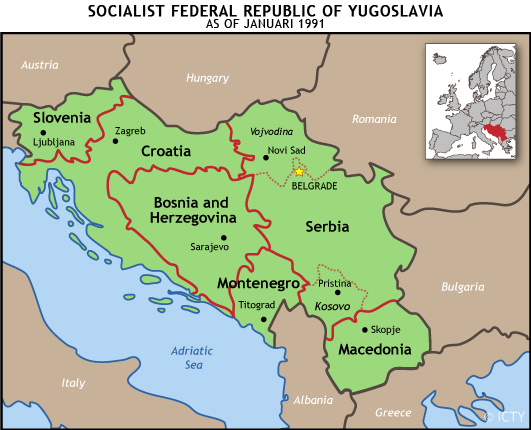
Yugoslavia was not a name given to one particular and cohesive country, but a name given to a conglomeration of disparate republics and independent states. In fact, Yugoslavia was, until 1929, only a colloquial name given to this amalgamation of states: the provisional State of Slovenes, Croats and Serbs, the Kingdom of Serbia, the Kingdom of Montenegro, Macedonia, Vojvodina, and Kosovo. Before World War II, this grouping of states was called the Kingdom of the Slovenes, Croats and Serbs (the Kingdom of Yugoslavia). Then, during World War II it was proclaimed the Democratic Federal Yugoslavia. Yet, over the years, many names have befallen the region - Federal People's Republic of Yugoslavia (1946), Socialist Federal Republic of Yugoslavia (1963) and the Federal Republic of Yugoslavia (1992).

 For 27 years, 1953-1980, Josip Broz Tito, through various distinctions such as prime minister and president for life, ruled Yugoslavia. "Josip...the leader of the Communist resistance movement [in WWII], appeared to be a loyal Stalinist. After the war, however, he moved to establish an independent Communist state," (Duiker and Spielvogel, 2006). Tito achieved this by lobbying the visage of Yugoslavian freedom to the world at large and taking a stance, not against Communism, but Stalinism in his creation of an independent Eastern European satellite state.

But in 1980, the Yugoslav president for life died and "no strong leader emerged, and eventually Yugoslavia was caught up in the reform movements sweeping through Eastern Europe," (Duiker and Spielvogel, 2006). And in June 1991, Slovenia and Croatia declared their autonomy, an action vehemently opposed by the Serbian provincial leader, Slobodan Milosevic - Milosevic ultimately served as president for the Serbian branch of the League of Communists of Serbia (1989-1997) and, ironically, as the president of Yugoslavia (1997-2000).

Consequently, due to Milosevic's assertions that the two new countries realign their borders to accommodate Serbs in those regions, Serbian forces attacked both Slovenia and Croatia in 1991. Although the Serbian army saw little success in Slovenia, they captured "one third of Croatia's territory," (Duiker and Spielvogel, 2006). And in 1992, three more territories declared their independence: Macedonia, Bosnia and Herzegovina. The Serbian army then turned their attention to Bosnia and Herzegovina and by 1993 had acquired some 70 percent of Bosnian territory.

But more than Bosnian territory was removed from the Bosnian people. "The Serbian policy of ethnic cleansing - killing or forcibly moving Bosnian Muslims from their lands - revived memories of Nazi atrocities in World War II," (Duiker and Spielvogel, 2006). One Muslim survivor recalls: "When the truck stopped, they told us to get off in groups of five. We immediately heard shooting next to the trucks... about ten Serbs with automatic rifles told us to lie down on the ground face first. As we were getting down, they started to shoot, and I fell into a pile of corpses...as they continued to shoot more groups, I kept on squeezing myself between dead bodies...," (quoted in W.I. Hitchcock, The Struggle for Europe: The Turbulent History of a divided Continent, 1945-2002).

As the international community neglected to take a stand against Serbian aggression, the fighting spread and continued until 1995 when a tentative cease-fire was agreed upon. But a cease-fire did not bring peace to the country of Bosnia which lost some 97,207 citizens (killed or displaced). A cease-fire did not correlate to peace in the region.

A new war erupted in 1999 over the autonomous Yugoslavian province of Kosovo - home to Serbian minorities. Milosevic, in 1989, stripped Kosovo of its autonomous status and, in 1993, the country's ethnic Albanian population founded the Kosovo Liberation Army to combat Serbian control and authority within the province. "When Serb forces began to massacre ethnic Albanians in an effort to crush the KLA, the United States and its NATO allies mounted a bombing campaign that forced Milosevic to stop. In the fall elections of 2000, Milosevic himself was ousted from power and he was later put on trial by an international tribunal for war crimes against humanity for his ethnic cleansing policies throughout Yugoslavia's disintegration," (Duiker and Spielvogel, 2006).

In 2004, the last visage of the former Yugoslavia disappeared when the country was renamed Serbia and Montenegro and was put under a new government. But, the independence of Kosovo and Bosnia are not completely decided. To this day, some 30,000 NATO forces remain in the region to maintain peace and control among the still aggressive factions.

Apr 1, 2010

Spring Break

So, spring break has come and gone and, of course, I'm still behind on homework. That's not to say I didn't complete some and try to complete all of my catch-up-work, but once again I managed to succumb to the plethora of temptations and distractions that accompany a week off from school.

I caught up on move watching, video game playing, guitar practice, and writing...not writing about what I had been assigned to write about, but what I wanted to write about. It is rare that I find time to write what I want, research what I want, and just relax...I couldn't pass up the opportunity as I haven't been able to pass it up for the past three and a half years.

While some students are mingling and rabble rousing along the Florida panhandle, along the beaches and in the hotel rooms of the Mexican coast or whatever it is Spring Breakers do, stereotypically, on spring break, I sat back, drank a few brewskies and made myself at home in my home...

And another thing: spring break, as I've been mentioning, is a break. I find it comical and, at the same time, depressing that professors and the academic world feel so completely and egregiously inclined to assign homework that is to be completed during spring break. Or, more vehemently, that they find it necessary to assign a test to be taken on the first day of school following spring break.

The only downside to a work-free spring break: a work-slammed week after. Ugh, back to catching up.

Mar 27, 2010

The Southern Party


In 1999, the League of the South sponsored the creation of the Southern Party which would, over the years, be little more than another minority party, obscure even, that would hold little clout in the American political system - at least in terms of voting and holding any true power in Federal government.

Across the South and mid-west, from states such as Texas, Oklahoma and Missouri to Virginia, South Carolina and Florida, members of the Southern Party, or members once affiliated with it, hold positions of office at the state and local levels. Back in 1999 when the party was first commissioned by the League of the South, more members were actively in office, but no members successfully gained office in any truly important faculties such as governor or senator.

The tenants of the party have changed little in the eleven years since its inception: states rights, lower taxes, small Federal government, the right to bear arms, and peaceful secession of the southern states to name a few.

The ideas lie clear in the following quote. In a 1999, George Kalas, then the party's chairman, was quoted by CNN, saying,  "We're kind of a nation within a nation. We had four years of independence as a nation to develop that separate culture. That is not co-optable. You can't co-opt our Southern heritage, you can't co-opt our Southern drawl, our Southern cooking, our Southern music, our deep religious faith."

To be more specific, the tenants are very similar to those subscribed to by the League of the South and truly, the League has become the new Southern Party and, most likely, always was. The League has stepped away from its figurehead role in more recent years and assumed a more active stance in the absence of the Southern Party proper - the party essentially dissolved in 2003 after years of infighting between leaders and several factional splits.

Today, the views and ideologies of what the party stood for can be heard through the voices of such individuals as Michael Hill, president of the League of the South, and Donnie Kennedy, a neo-Confederate who attempted to receive the 2008 presidential nomination of the Republican party.He left the campaign in December 2007 as he believed, having brought the issues of southern rights to the main stage, other matters would need his attention and the attention of the League during the election.

It is possible to contend Kennedy and the League saw futility in the enterprise or simply were, as Kennedy suggests, wanting to bring the issues to the forefront that were close to their hearts. Either way, the League has seemed to garner little attention outside of the South as many, but not all, of their views coincide with those of the Republican party... and, moreover, the League may lose clout due to their perceived fanatical stances on many, many issues.

Mar 22, 2010

Playstation Move

Motion controls. I'll  be the first to criticize them and the last to take them in with open, unquestioning arms. When the Wii shipped some three years ago, I was excited, ecstatic even, with the concept of another innovative Nintendo system; I was and am a huge fan of what the N64 did for gaming and what it brought to the table. But what got me about the Wii was not stellar graphics or a great and promised catalog of games - neither of which ever came to fruition - but the one innovation that, seemingly, promised to change the atmosphere of gaming: motion control.

To be honest, I never bought a Wii. I was holding out for Sony and the PS3, but I played the Wii every chance I got and came very close, my hand reaching into my back pocket to my wallet at Wal-Mart, to buying one.

The reason this never happened, why I don't have a Wii sitting in my room, but a PS3 in my entertainment center, is that it just got boring. For me, at least, the motion controls didn't, in the long run, make up for the shoddy library and the egregiously embarrassing visuals of the Wii. On certain games - Wii Sports, Red Steel - the latency was bearable, yet in others - World at War, Smash Bro. Brawl, it was frustrating at best.

Quickly, the novelty wore off. And not just for me, but for many gamers. It was fun while it lasted, but motion control just wasn't ready, the research and technology wasn't where it needed to be. Nintendo has made it this far catering to the family-centric gamer, not the hardcore, more critical gamer.

And that's what it seems Microsoft and, more importantly, Sony are trying not to do - leave the hardcore gamer out in the rain. At this point, I haven't heard much positivity regarding Natal - information has leaked that developers are having trouble with Natal, that Natal isn't as responsive or as able to recognize images as was originally touted. But those are all, truly, rumors. The point here is that Playstation Move is the only real pertinent and promising motion controller right now.

I'm excited because of the possibilities - one-to-one- latency, backwards compatibility with older PS3 games through downloadable patches, etc. I'm nervous because of the risk - PS3 could trod the path of the Wii and become old hat within the first few months to a year.

Even being a huge critic of motion control and seeing it more as a gaming augmentation rather than control within itself, at this point I see the potential in the technology. Sony could truly make inroads into the the technology's future. I can see the Playstation Move, with all of its advantages such as one-to-one latency, backwards compatibility, more pertinent titles and titles that appeal to a larger gamer-community, laying the foundation for motion control standards and future projects.  

 We'll just have to wait until E3 and more emphatically, Fall 2010 to truly find out. Maybe, motion control will become more than a novelty and child's play. Maybe motion control will defy its critics and become necessary and wanted, not just a cumbersome periphery.


Mar 20, 2010

Machiavelli

Nicollo Machiavelli, born in Florence, Italy, was a writer/philosopher and is considered to some, not all, to be the originator of modern political science. Most recognized for ideas expunged through his work, The Prince, a short treatise published in 1532, Machiavelli has been studied by numerous political theorists over the years and been demonized and heralded alike for his insights into political thought and execution.

Derived from his life experiences, Machiavelli, who was born and lived through some of Florence's most politically tumultuous years, wrote, in The Prince, the guidelines of how a prince, or any ruler for that matter, should go about governing his kingdom - governance should ultimately be in the best interests of the government, not necessarily the populace. What this means is that a prince, or ruler, who holds the throne and is in control of the government must create a stable, virtuous state and the actions taken to do this are inherently necessary no matter the cruelty constructed through enterprises used to reach such an ends.

Machiavelli stressed the break in realism and idealism - he posits that a ruler must be actively and, beyond reproach, a public figure, one that connects with his people, at least on some level, yet a politician that can act amorally, if need be, to reach the goals set forth by the himself and the state. This is all permissible if the goals of the state are, ultimately, goals that further the overall good of the state. Machiavelli defines morality in a political sense - it is an agent that is swift and, to an extent, short lived. Machiavelli acknowledged the ironies and paradoxes his ideals created - to the point that good results, not always, but normally, spawn from "evil," or amoral actions.

Many theorists argue over whether Machiavelli was a realist or acting as a catalyst, through his writings, mainly The Prince, for the political regimes of the time. Some believe that Machiavelli was simply, through treachery, an agent he ironically supported in his writings, leading the politicians of the day astray. He was giving politicians of the day advice to lead them politically astray and change the chaotic political environment in which he lived.

Yet, all of this speculation is simply that, speculation. But what is certain is that many politicians, those relative to Machiavelli and those future, agreed with him in some fashion. Take early American politicians such as John Adams, who also studied Montesquieu, as an example.

Machiavelli's ideas of cyclical societal and governmental decay and growth, which occurred naturally throughout societies, and that humans are creatures of emotions and decisions, were shared by Adams and other early American political minds. Moreover, Machiavelli's ideas concerning systems of checks and balances (found in his writings entitled Discorsi), obviously had some effect of the Founding Fathers, most of whom had, at some time, read Machiavelli.

But it is best to view Machiavelli as one of the first serious political scientists of the modern era. If anything, Machiavelli questioned the way in which politicians thought, acted and interacted with the populace they governed. If anything, Machiavelli, along with Montesquieu, Algernon Sidney, and other political philosophers of the time, planted the seed of thought that led to or at least helped to lead to the theories and ideals found in many democracies and republics around the world, ideals that are continually being augmented and implemented in new and varying ways in the everyday.

Mar 10, 2010

Review: Serenity

Swooping spaceships, secret military experiments, terraformed planets and interplanetary bank robbers. Serenity (2005) is a science fiction thriller/comedy that pits a crew of bandits, along with a girl, River Tam, and her brother, whom the crew took aboard, against the "Alliance," a seemingly omniscient governmental force akin to that of the Galactic Empire in the Star Wars films.

River is being, through some type of psychosis, conditioned into a type of assassin and her brother, the doctor, continually hides information from the crew as to what her importance is and why, exactly, the Alliance is chasing the crew to find her.

It is only hinted at, early in the film, that she may have been privy to some sensitive, top-secret, governmental information. But here, the plot becomes convoluted. It is never really told why the Alliance gassed the planet of Miranda or why River, except the given reason that she just "picked it up" during her treatment to become an assassin, is interested in this planet. The plot rests on no real evidential or emotional foundation. Any information given as to why all of this is happening is skimmed over at best - nothing is really given the amount of screen time it deserves in regards to plot explanation.

I never really felt connected with any of the characters - I never felt invested in the problems at hand. Why should I care the planet was gassed, all its inhabitants killed, when River, the person most connected, although only through association, with the event didn't seem to really care? The only time I felt truly connected was when Malcolm, the captain, fought within himself when confronted about leaving a settler behind to become a victim of the Reavers early in the film.

Not to say there were not redeeming qualities, but those qualities were not consistent with the feel and verisimilitude of the film. The comedic relief was welcomed, but it clashed with seriousness of the film and the task at hand - in fact, it undermined the overall plot and only reinforced its unbelievability. When the film shifts from serious to comedic and back at random it jostles the viewer around and adds confusion to an all ready convoluted plot. I would have rathered the film be comedic or serious, not attempt to be both.

Overall, Serenity is a decent movie worth a rental. It has some serious plot holes and is far too spastic in plot and acting leading the viewer to never really know the intentions of the characters or the storytelling.

Mar 4, 2010

Oceanography

Oceanography is a branch of the science of geography - oceanography is a marine science. It covers marine organisms and oceanic ecosystems, the shifts in those ecosystems, plate tectonics, oceanic chemical fluctuation, dynamics of oceanic processes and the geology of the ocean floor, among other things. This sub-science of geology requires practitioners to be well versed in other sciences such as chemistry, biology, physics, cosmology, and of course, geology.

Oceanography has four tributary, sub-branches that are specifically tailored to certain fields:

Biological Oceanography: The study of oceanic organisms, plants, animals, and ecosystems.

Chemical Oceanography: The study of the chemical interaction of the ocean, land, and atmosphere, as well as the chemistry of the ocean itself.

Geological Oceanography: The study of plate tectonics, the ocean floor, under-ocean volcanoes, deep sea vents...etc, etc. Can work close with volcanology.

Marine Physics: Physical attributes of the ocean such as tides, currents, salinity, temperature, and the behavioral interaction of the ocean and sound, light, and other elements of the electromagnetic spectrum.

Oceanography is not a new science. Man has always been interested, as evident by writings of Aristotle, about the oceans and their inter-connectivity with man. In its early years, oceanography was confined to man studying only the ocean's surface or, if at all, only its very shallow depths. But oceanography has branched out, as seen from the above, to encompass a wide variety of studies to help man better understand the oceans and their importance to the overall ecosystem of the world.

The importance of oceanography should not be belittled. The study of the ocean aids in man's understanding of the fluctuations of temperature and weather, among other things, across the entire planet. The Gulf Stream, for example, is a major and influential player in the climates and weather systems that are found in and affect both the eastern United States and western Europe. Moreover, it is necessary to understand the ocean floor and the microorganisms found living in and around hydrothermal vents in order to, not only understand the tectonics on the ocean floor that affect the surface, but how the organisms live in such conditions, how life forms in such conditions and how, possibly, life formed on fledgling Earth.

There are many more reasons Oceanography is a valid and valued science such as the way NASA studies the ocean to learn about the atmosphere and its similarity, or disparity, to oceans found on other worlds in our solar system. But all of those reasons are far too many to fit on this blog page. This are simply facts to generate interest...so get out there and find out why the ocean is so important.

Mar 3, 2010

Budget Cuts in Education: GSU

 The University System of Georgia is proposing a $300 million budget cut to take effect next year, a cut that severely affects the quality of education within Georgia's institutions of higher learning.

At Georgia Southern University, the cuts are manifesting in faculty cuts and class reconfiguration. In fact, several majors have either been consolidated or dropped all together. Students that aren't considering transfer are having to wait longer to receive their degrees, possibly, as many upper division courses are being cut across the board in many colleges.

This can explain things a little more...