Apr 20, 2010

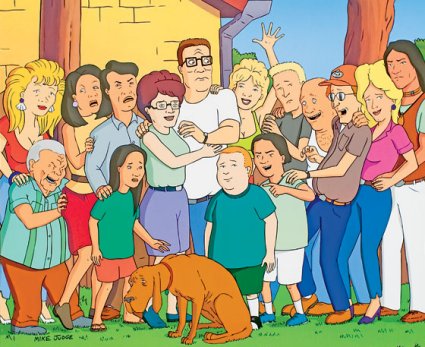
Cultural Representative: King of the Hill

"[King of the Hill is] the most acutely observed, realistic sitcom about regional American life bar none... this animated series is a lot like its protagonist, Texas propane salesman Hank Hill: it isn't flashy, never gets a lot of attention, but it does its job year in and year out," (Time.com).

It hasn't been until relatively recently, within the past year or so, that I've come to see King of the Hill as one of the most seminal and relevant cartoon-coms on television (although canceled in 2009 after 12 years and now syndicated).

King of the Hill, like the opening quote puts so eloquently, doesn't don any aloof airs, shove its ideals or ideas of right and wrong down your throat, or showcase slapstick, quirky or hyperbolic comedy for the sake of shock value and entertainment - yeah, Family Guy, I'm talking to you...

With their quintessential middle-class American mindset, the Hills invite you, the viewer, into their everyday lives, lives that are not much unlike any of ours. And the fictitious town of Arlen, Texas is not much unlike any suburb in America nor is the neighborhood on Rainey Street in which the Hills reside. Every aspect of the world created to fit the King of the Hill universe has an analagous within our every day lives.

Hank Hill is the average every-man - he works his fingers to the bone to sell propane, he tries his best to please his boss, yet maintain a healthy relationship with his co-workers,  he provides for his family as best he can and he is obsessed with lawn maintenance.Through him we see all of our apprehensions of sexual identity, intimacy and emotional connection or disconnection from those around us, those most important to us. He is emphatic about sports - a huge Texas Longhorns fan.

Peggy Hill, Hank's wife, is definitely the quintessential melodramatic suburbanite. With an inflated sense of intelligence and verbose naievity, Peggy more than often shoves he foot directly into her mouth, yet rarely realizes until the situation directly affects her. She views herself as overly-knowledgable, clever, cunning, and supremely attractive - she is a poor real-estate agent, mediocre newspaper columnist, and horrificly sub-par Spanish teacher. More often than not, Peggy's ego will champion her inability to see the long term effects of her actions until themoment has arrived through which the agonizing realization of her actions is manifested.

The Hill's son, Bobby Hill, is the typical prepubescent 13-year-old boy - his character, being written to be around this age, allows Bobby to encompass both the teenager and the child, thus making his mindset an amalgam of both. Bobby is ot a huge fan of sports, is not self conscious about his image or pudgy belly neither is he on-beat with his sense of humor. Bobby is often found participating in activities traditionally seen as feminine - cooking, fashion, and playing with dolls at times. He is a reflection of Hank's discomfort and Peggy's confidence and thus, a representation of not only teenagers and children, but of us all completely.

I could press on and delve into the characters of Dale, John Redcorn, Bill, Boomhauer and Luane, but I believe the nucleus of King of the Hill resides in the nuclear family of the Hills. Surrounded by all the quirky neighbors, the stereotype of "redneck" - of which the Hills are constantly branded - and rough times, the Hills remain true to themselves, an ideal we can all relate to.

Apr 15, 2010

Behavioral Finance


"It [behavioral finance] focuses on the psychology and behavior of individual economic agents, and explores the implications for asset pricing, regulation and management," (The International Center for Finance at the Yale School of Management).


Behavioral finance is the study of how individuals determine and rationalize their market decisions. In other words, it is the study of the actions, cognitive processes, emotions, and social triggers and catalysts that guide people through any economic endeavor.

"According to conventional financial theory, the world and its participants are, for the most part, rational 'wealth maximizers'. However, there are many instances where emotion and psychology influence our decisions, causing us to behave in unpredictable or irrational ways," (Investopedia.com). 


With the aid of other sciences such as economics and psychology, behavioral finance seeks to explain the unexplainable anomalies that arise in the accepted, conventional financial theories of  the capital asset pricing model and the efficient market hypothesis

Essentially these theories posit that consumers continually and will always act rationally and with their best interests in mind - maximization of money and time. Yet, in the real world, these theories run into serious roadblocks.

For example:  "In most cases, however, this assumption doesn't reflect how people behave in the real world. The fact is people frequently behave irrationally. Consider how many people purchase lottery tickets in the hope of hitting the big jackpot. From a purely logical standpoint, it does not make sense to buy a lottery ticket when the odds of winning are overwhelming against the ticket holder (roughly 1 in 146 million, or 0.0000006849%, for the famous Powerball jackpot). Despite this, millions of people spend countless dollars on this activity," (Investopedia.com).


So, consequently, and due to anomalies such as the above, a new branch of financial theory was created out of necessity. But what are the accepted anomalies exactly? What are the key concepts that truly set behavioral finance theory apart from CAPM theory and EMH theory? 

Here are some of those concepts and anomalies in summation:


Key Anomalies:
January Effect - This phenomenon is essentially an explanation for increased monthly returns in the month of January. Conventional financial theory persists that returns and stocks should appear uniform throughout the year - never truly spike or trough. It is thought that the spike in January is attributed to increased December stock selling in order for businesses to receive greater tax-losses...the stocks spike in January. 
The Winner's Curse - In a nut shell, the Winner's Curse is the theory that the winning bid over a stock often exceeds the overall, intrinsic value of the stock [ or item or what have you]. It posits that, unlike traditional financial theory, often times the individual is not privy to all information concerning the item being bid upon and that, more emphatically, that the individual most likely does not know the true, overall value of the asset. 

Example: "The more bidders involved in the process means that you have to bid more aggressively in order to dissuade others from bidding. Unfortunately, increasing your aggressiveness will also increase the likelihood in that your winning bid will exceed the value of the asset," (Investopedia.com).


Key Concepts:
Anchoring - The concept of attaching our thoughts to a relevant reference point no matter the relevancy to the situation at hand. This can cause irrational thoughts and ideals to cloud judgment and allow for bad or illogical decisions. Critical thinking is imperative in fighting anchoring and correlating all events to on reference point. 
Example: "Some investors invest in the stocks of companies that have fallen considerably in a very short amount of time. In this case, the investor is anchoring on a recent "high" that the stock has achieved and consequently believes that the drop in price provides an opportunity to buy the stock at a discount," (Investopedia.com).
Herd Behavior - Humans have the inherent ability to form large, cohesive groups, groups in which a majority of individuals mimicked the actions and, likely, thoughts of a minority. This happens through the innate need of humans to be accepted into a group and once accepted, their need to conform to the group standards. 

For example: "If a herd investor hears that internet stocks are the best investments right now, he will free up hisinvestment capital and then dump it on internet stocks. If biotech stocks are all the rage six months later, he'll probably move his money again, perhaps before he has even experienced significant appreciation in his internet investments," (Investopedia.com).

These are just a few concepts and anomalies looked at in more depth at Invesotpedia.com. Although this post uses the website for much of its information, there are many other sites and sources such as Wikipedia, The Journal of Behavioral Finance and the School of Economics and Management, in which information is provided on this topic in a more in depth analysis. 


Apr 13, 2010

Letter to the Editor: Gamepro

Dear Editor:

I'm writing in regards to a piece in last month's issue that discussed the relevancy of Metacritic and it's scoring system. Being, what I consider, an avid gamer, I find it somewhat disturbing that score, it seems, has become everything: the life and death of games hinge on it. I also find it disturbing that so many gamers place so much faith in the decision of one site, even if it supposedly pools scores from multiple sources.

How, ultimately, does Marc Doyle and crew decide what gaming sites and reviewers to include in their secret, algorithmic potion? Oh sure, it's great that Metacritic divulges a list of full reviews from sites ranging from IGN to Playstation: The Official Magazine to Eurogamer to Playstation Universe, but, as is noted in the article, what's the use for reviews when there are scores plastered at the top of every review link?

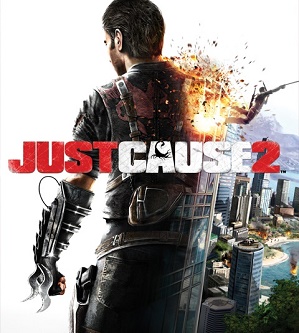
Take, for example, Gamepro's review of Just Cause 2. Gamepro's review firmly left the game with three stars and cited more cons than pros within the game. Metacritic firmly scores the game an overall 83 just above the summary at the top of the page. Thus, the first thing seen is the score glaring right back at you. Why continue down the page if the score is right there, if the score is all that matters?

And, I'm sure, as I've seen on Gamepro.com forums and replies, many that gave the game a low score have been touted as being overly harsh of a game that has made significant improvements over the previous installment - but these criticisms seem to be a Metacritic ailment. Again, don't disagree with the review-gurus or stand to face the consequences.

But the point here is this: I like Just Cause 2 and yes, reviews and scores are helpful to gamers, but ultimately just because a critic/reviewer proclaims a game sub-par or horrendous even, doesn't mean that game is sub-par or horrendous - it all depends on the player. One player's horrible experience is another's wonderland.

And that's why, I think, a combination of review and score are necessary on a site like Metacritic or, for that matter, any gaming publication, online or print. It is necessary that the score, at least, be below the review so that the score is not taken at face value, but is corroborated by, at least some, evidence.

I think a lot of great games get thrown to the wayside because reviewers are seen as absolute and scores deified. One site, review, or score should wield the power of life or death over any game.

Apr 12, 2010

The Visit: Review

To say the least, I was not overjoyed with the prospect of being assigned play-review duty. It's not that I am allergic to theater, it's that I've seen, over my tenure at Georgia Southern University, a plethora of nail-grinding, yawn-able, a just down right repellent performances. But, suffice it to say, and to my excitement, The Visit was by far, the best exhibit of theater I have been privileged to attend in quite some time.

The Visit revolves around the morally ambiguous characters of Clara Zachanassian and Anton Schill as well as the poverty stricken town folk of Güllen. Without giving away the entire plot, I'll say this: Zachanassian gives the citizens of Güllen the option of obtaining 1 billion Deutsche Marks in turn for a favor they must give her. The favor, the catch, is that one of their own must give up his/her life. An intriguing, yet unoriginal premise that through the overall story and intricacies of character becomes more a tale of internal struggle and a commentary on the implications and ambiguities of real life scenarios than a theatrical melodrama or run of the mill Lottery rip-off.


Overall, the acting was, by far, the best element of this particular rendition. Every scene exuded a realness that was only achieved through the actors - their voices, their movements and their gestures almost perfectly mimicked the complex emotions of fear, hope, judgment and self-redemption that are interwoven into the overall narrative. The only complaint I have in regards to the acting is that several of the actors [Pedro in particular, Zachanassian's current fiance'] did not project their voices as much as is needed to reach all ears of the theater. Moreover, the station master was out of place: instead of fluid dialogue recitation, his lines were delivered mechanically, as if he were having to think of each sentence before it was said. But it wasn't a deal breaker.

The only other pet peeve I had with the play was the pronunciation of the town: Güllen. The play is set somewhere in Germany [ the playwright kept the location anonymous as he wanted to keep the air of "this could happen anywhere" (Wikipedia)]. Now, other German words were pronounced correctly [Frau, Herr, etc.], yet the name of the town was constantly pronounced Gul-len...it is correctly pronounced Goo-len. If certain words are pronounced correctly, this should have been too - mispronunciation took me out of the verisimilitude of the play. But, on the other side of the argument, most theater-goers would not know, especially locally, that the name of the town was mispronounced.

It just took me out of the story, distracted me from the superb acting, and made me grind my teeth in frustration ever time it was uttered.

But those little peeves and complaints aside, I would love to see The Visit performed again and by these individuals. The experience was a much welcomed change from the typical melodrama and the blockbuster mentality that is Hollywood. To say the least, it was a Saturday night well spent and a play I would recommend.

Apr 8, 2010

Production and Price Control in WWII America

By 1941, the United States was pledged to entering the Second World War. Japan had attacked Pearl Harbor in an unprovoked display of aggression intended to cripple the United States navy preemptively and the fascist Third Reich is knocking at the door of Great Britain and turning its sights on the U.S.S.R.

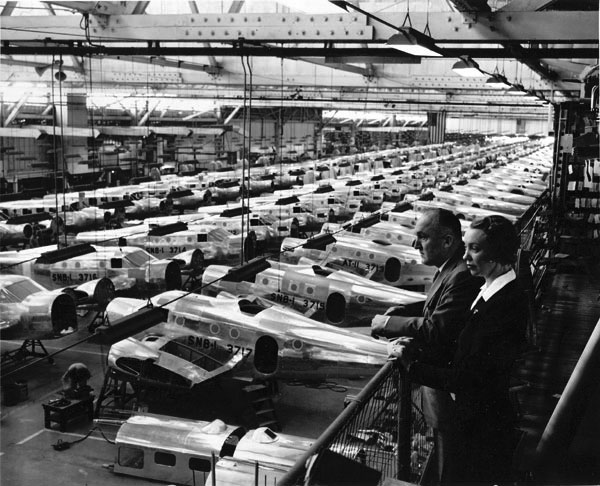
In the U.S. citizens still reeling from the Great Depression found the war, ironically, to be an agent through which the economy and industrial sector could  bounce back, get back on its feet and charge into the future. Automobile manufacturers began building tanks, aircraft and other military vehicles while other public sector factories created ammunition, rations and other military gear such as fatigues and rifles.

So, to allocate materials and regulate production of these products, as well as items such as fuel, Franklin D. Roosevelt commissioned, through executive order, the War Production Board in January 1942.

In a speech dated January 6, 1942 President Roosevelt spoke to the American people, telling them of what must be done to attain the final ends of victory in the recently pledged war. He said: "The superiority of the United States in munitions and ships must be . . . so overwhelming that the Axis nations can never hope to catch up with it . . . to attain this overwhelming superiority, the United States must build planes and tanks and guns and ships to the utmost of our national capacity. We have the ability and capacity to produce arms not only for our own armed forces, but also for the armies, navies and air forces fighting on our side. . . This production of ours . . . must be raised far above its present levels, even though it will mean the dislocation of the lives and occupations of millions of our own people. We must raise our sights all along the production line. Let no man say it cannot be done."

And the War Production Board did just that - it raised production, lowered and, eventually, prohibited nonessential productions and created a priority scheme that dictated the distribution of services and materials. Metals, rubber, plastic, gasoline, oils, and so on and so forth were rationed by the board.

The board was disbanded in 1945 following the defeat of the Japanese Imperial Army. Yet throughout its four year lifespan, the board produced some $185 billion in military supplies, both in ordnance and logistical supplies such as medicine, gasoline and fatigues. 

Yet production and allocation were not the sole inhibitors and allocators in the economy of World War II America. Price control also played a pivotal role.  Almost five months prior, in August 1941, the Office of Price Administration opened its doors in an attempt to control prices following the outbreak of the war. This administration was also brought into being via executive order.

"Besides controlling prices, the OPA was also empowered to ration scarce consumer goods in wartime. Tires, automobiles, sugar, gasoline, fuel oil, coffee, meats, and processed foods were ultimately rationed," (Encyclopedia.com). Moreover, the OPA had the ability to instate price ceilings and at the peak of the war some 90% of food stuffs were frozen under rationing - the Office often authorized subsidies for commodity production.

The OPA and all of its affiliates, such as the transference of its abilities to the Office of Temporary Controls, was abolished in 1947. Sections of its control were transferred to differing agencies such as the Department of Agriculture and Reconstruction Finance Corporation for a limited time.

But ultimately, organizations such as the OPA and WPB brought the United States, through WWII, out from the grip of the Great Depression. Increased wartime production brought many jobs to the exorbitant amount of unemployed, kicked started the economy and brought a huge and, as of then, highly unexploited asset to the forefront - women workers: Rosie the Riveter. And, in hindsight, the rationing aided the troops serving in the European and Pacific theaters much needed supplies and morale. 

Here, another agency, the War Manpower Commission, a commission created to bring workers into the production force, one directly related to how and through what means the OPA and WPB functioned, is explained...


Moreover, organizations such as the OPA and WPB have operated off and on continually in war times following WWII - wars such as the Korean and Vietnam wars. Today, in our modern economy, such drastic measures are not necessarily needed as recent conflicts have not been on scale with the production needs found in WWII and following wars. Yet, if the wars in Iraq and Afghanistan were to escalate or go on for extremely long periods of time and our current economic situations were to somehow plunge for the worst, similar sanctions and regulations could, in theory, be implemented...

Apr 7, 2010

Expectations of Summer

Summer. Summer is definitely my favorite and, paradoxically, most disdained time of year. Every winter I long for its coming, can feel it pulling itself up and over the horizon, teasing me to come along and romp with it along the beaches and lie with it on floats in a swimming pool. And when it comes every April, summer laughs at me, its hot breath suffocating me, drenching me in sweat...

And, yet again, I feel that this summer will be another of hot, sticky days, kinds of days where underwear sticks to all the crevices and divots you never knew your skin had, days where the heat exhausts you and you pass out in a lawn chair only to wake up with scorched skin.  O.K. Maybe a little dramatic, but it happens...

But this summer will be different in one, glaring way - I will be graduating. Finally, I will be done with higher learning in regards to how it is an institution that promotes learning what everyone else deems is the truth. Finally, with exorbitant anticipation, I will be able to afford the time to study what I want to study, what I want to jam into my cranium, what I want to pursue. 

I guess, maybe, at this point, I have some vendetta against organized education...I don't really have a reason. It's just a feeling I hold right now and a feeling I'll have to discard to pursue my MFA in writing - but there [at Goddard, Iowa, etc.] everything is more focused on the you, what the individual really wants to learn.

That's always been my problem - taking orders. And in the spirit of summer, by hook or by crook, I can't wait to completely and utterly embrace the learning and life that is right for me [music, writing, video games]. 

Oh, and that's not to say I'm not completely horrified by the notion that I am, now, officially an adult and part of the overall framework of the world. I mean that I am horrified by the notion of becoming self-sustainable, becoming superbly responsible for myself and those in my life, becoming, to quote the Burbs', the guy "up at the crack of dawn watching a dog poop." I say this because I see myself, still, as a big kid...but alot of the time, don't we all...don't wee al think that, want that to be true?

So, I guess instead of writing about summer, I found I really needed to rant about education and my future life - I needed to practice stream of consciousness writing for a change...just write uninhibited...throw caution to the wind...and, in a strange elopement, take summer in hand and absorb its laid back mentality as I enjoy it for the last time before adulthood.

Politi-toons


It seems, even as diplomacy is tried and tried again, and even as the world community attempt to become and assume the role of the middle man between these two nations, Palestinians and Israelis will continuously fight over the Gaza strip and among one another. The irony is that what they are fighting over will never be completely won unless the opposing side is utterly demolished. As the cartoon depicts, Palestinians and Israelis will fight up to the very end.

This cartoon, in many ways, speaks for itself. I enjoy its snarky attitude towards an official that has, in many ways, inflated her ego to outlandish proportions through means more in keeping with reality television stars than anything else. The commentary on how she has fully embraced the celebrity of modern politics his also profound.  Don't get me wrong, I'd watch it, the show I mean...I'd watch it with all the levity and seriousness I stock in the Real World or Big Brother.

This a complete microcosm for how, at least I, myself, feel about the corporate insurance industry. With all the loopholes they have made for themselves through clever and obtuse writing techniques [and through the help of lawyers], all of the companies who promise they'll be there like a good neighbor and lend a helping hand have made it easy, almost through no work at all, to deny claims and put millions of people in debt. Of course, it's not all the insurer's fault - debt is not wholly contributable to this as I may have implied above - but also the fault of the American government's for enabling it and the American people's indifference of it, acceptance of it, and defeatist mindset of "that's just how things are."


I think this cartoon sheds light on the many mindsets that Americans share when it comes to obesity and overeating/over-drinking [i.e. soft drinks, beer, etc.]. Many individuals, it seems, have this mindset that if a food or drink is available, such as junk food at school, they have to eat it, or they become inflamed at not being given choices - the choice is easy: eat it/ drink it or don't. But I also see the flip side in that places such as schools should provide nutritious snacks as students can't all day without eating. This cartoon sheds light on both sides of the argument in an interestingly subtle way.

Being a soon-to-be college graduate, this cartoon sums up my feelings about heading into the world and the wounded job market. The only thing I would change about this is to add a cushion at the bottom that said DEBT.

Apr 5, 2010

Piece of Art? A Look at Snuff by Chuck Palahniuk

The assignment in my Opinion Journalism class was to review my favorite piece of art. I could, in fact, easily review something I hold in high esteem, something I dote over such as a painting, a film, a video game (yes, video games have finally become an art form), or a novel, short story, or poem. But, as having read Snuff recently and finding it to be somewhat lacking, I began to think: How difficult is it to review something, with utter fairness, that is, quite frankly, lacking. And, moreover, review that lacking piece of art that is spawned by a beloved artist, one also held in high regard. Here, I decided to delve into the world of Chuck Palhaniuk's Snuff...a novel I both admire for its showcasing of a writer branching out and venturing down new and unknown avenues of creativity and a novel that I, in the other hand, abhor for execution and style....


I'm not an avid viewer of pornography or a connoisseur of the taboo and I'm not saying Vancouver native and Fight Club author Chuck Palhaniuk is, but he does provide a strong case in his fictitious porn-scape, Snuff. A satire from the view of five individuals (Mr. 600, Mr. 137, Mr. 72, Sheila, and porn-goddess Cassie Wright), the story sheds light on a record breaking adult-film- a 600 man gang-bang. But in most parts, the story only gets deep enough, intimate enough, to show us sex; it never really shows us why we should care about what's going on or how the characters feel, or how they fill their “Palahniuk-voids.”

Palahniuk has a style that often leaves his characters with gaping, rotten-flesh wounds, schizophrenic baggage that somehow relates to all us saps that dig into his stories with rabid vigor. But here there is no surgeon, no gun-in-mouth epiphany, or psyche-ward afterward to sew things up, to show us the meaning behind it all, to show that the characters really are characters we could encounter in everyday life, that we could connect with- characterization just falls flat.
  
So, we trudge along as Cassie digs her way out of regret for her long lost “porn-baby” - some reverse ego-trip- and gets her wounds filled with all kinds of gruesome and raw phallic devices,- “tangy, ranch-flavored erections”- but never anything true or rewarding or redeeming. And we can say that about Mr. 600, the porn-o-sapian fossil who, in some ways, is responsible for Cassie's situation. And Mr. 137, the failed television star. And Mr. 72, the Cassie Wright heir wannabe who is trying to save his mother from death by dick.

All the characters are “flesh and blood, but like something's exploded inside” of them, leaving them lifeless.  So, through all the failed parenting, adolescent soul searching, reminiscing, and vanity, we are only left with some strange, Palahniuk-fused monstrosity of entertainment and northwest-hipster culture doused in the triple-x.   
 
 And doused in gruesome detail as well. True to his style, Palahniuk describes dildos, intercourse, condoms, blow up sex-puppets, and countless rare and strange sexual abnormalities to the most hideous of detail, painting us a picture that sometimes could have been omitted. And although Palahniuk's devotion to tabooish detail gives up images that are laugh out loud funny and, at times, pukingly vulgar, he fails to cue us in to the drab surroundings of the 600 gang-bangers. All we know about the backstage area is that there are monitors and monitors and monitors showing Cassie Wright in sexcapades, a bar with nachos and chips and punch and hot-dogs, and gray voids- everything is claustrophobically-gray and dark and vague. Except Cassie who is robed in white light – goddess.
  
So, with this strange juxtaposition of detail, we know about some strange fascination with gang-land tattoos, superfluous celebrity trivia, sexual innuendo, cockamamie porn-film names like “World Whore 1,2,and 3, Gropes of Wrath, and The Wizard of Ass,” but not much of the actual setting or the outside world.
  
But maybe setting isn't important and growth isn't important and zany names aren't important. Maybe this time it's about entertainment for entertainment's sake. And if this is the case, all of Palahniuk's research and hard work and determination to showcase the culturally hip, yet forbidden reality of pornography paid off. And maybe he is telling us something by not showing it all.. Maybe that in itself means something.
  
Mr. 600 says, “Dudes have a million ways of peeing on what they claim as there own,” and Palanhiuk reminds us that shock-writing is his territory by entertainment to prove it. So, read this if you just want to sit back, relax, and be shock-and-awed. Don't expect to find the meaning of life here.